
Why is embedded key exchange the foundation of quantum security?
Myths surrounding symmetric key distribution often obscure the conversation around true quantum security. Learn why embedded, asynchronous key exchange offers simpler and more robust protection for a quantum-secure future – without additional risks.
Uli Schlegel
While the industry is working hard to keep networks secure for the quantum age, some providers are promoting the external management and distribution of symmetric keys via additional channels as the superior approach. This creates the impression that this technology increases security.
This narrative has led to considerable uncertainty in the market. Customers are asking whether such architectures actually offer more protection than established approaches – and whether existing solutions could be at a disadvantage in the future.
But the truth is much simpler and, at the same time, more reassuring: symmetric key distribution is not the central bottleneck on the path to quantum-secure networks. On the contrary, setting up external infrastructures for key distribution creates new points of attack and introduces additional complexity.
It’s therefore time to dispel the widespread misconceptions, clearly identify the real risks and show why embedded, asynchronous key exchange – as implemented in Adva Network Security's secure transport platforms – provides a more robust, simpler and more resilient foundation for quantum-secure communication.
Myth 1: Quantum security requires new, external systems for distributing symmetric keys
This is one of the most persistent misconceptions. Symmetric methods such as AES 256 continue to offer a very high, albeit slightly reduced, level of protection even against attacks by quantum computers. This is independent of the generation of symmetric keys. The AES algorithm forms the core of payload encryption for all manufacturers.
The real threat lies in asymmetric cryptography. Algorithms such as RSA, elliptic curve-based methods, classic Diffie-Hellman methods and many widely used signature algorithms are vulnerable to Shor's algorithm and must be replaced by post-quantum cryptography (PQC).
The reality: Symmetric keys remain strong. The key is to consistently replace vulnerable asymmetric methods with PQC.
Myth 2 : Synchronous key distribution infrastructures offer superior security
Some manufacturers offer solutions in which symmetric keys are generated, managed and distributed via a centralized external server or separate key management software. This inevitably introduces new and diverse areas of vulnerability. These risks do not exist if key exchange is implemented directly within the device itself, both at the hardware and software level.
External key distribution significantly increases the complexity of the overall system and, in turn, the attack surface. Side-channel attacks become more likely, and the risk of misconfiguration or manipulation increases with each additional component. In addition, there is a dependency on an external, often centralized infrastructure, which can become a single point of failure.
Each additional interface expands the security perimeter and increases the operational effort required for security, monitoring and auditing. Certifying heterogeneous systems with numerous software and hardware components over their entire lifecycle is difficult to maintain consistently. For this reason, many manufacturers rely on architectures where the portion to be evaluated remains as small as possible.
The reality: Transferring keys via external connections does not improve security. It increases the attack surface and shifts trust to external components. In many cases, key distribution is only protected by traditional cryptography, which significantly weakens the intended level of security. A system is only as secure as its weakest link.
Myth 3: QKD or special key exchange procedures offer better protection
Quantum key distribution is often presented as the ultimate solution for securing modern transmission systems. The basic principle is simple: QKD transmits random numbers in a way that’s secure against eavesdropping, even against attacks by quantum computers. These random numbers are then used to derive symmetric keys for further use.
In practice, however, QKD poses considerable challenges. The technology relies on its own physical connections and offers only limited ranges. It’s also susceptible to interference, can be compromised by denial-of-service attacks, and still requires authentication of the distribution infrastructure based on classical cryptography. QKD therefore inevitably increases the complexity of the overall system – see Myth 2 for example.
The reality: QKD is not a substitute for post-quantum cryptography. Authorities such as BSI, ANSSI and NLNCSA unanimously point out that, due to its limitations, QKD is only suitable as a complementary technology in specific niches, while the priority clearly lies with post-quantum cryptography.
Embedded key exchange is simpler, more secure and more resilient.
Why embedded key exchange is the better choice
Modern encryption systems already enable fast, frequent and automated rotation of the keys in use. When this process takes place directly in the communication device, a self-contained subsystem is created without any external transmission of sensitive information – and therefore without unnecessary risks.
Adva Network Security's optical and Ethernet platforms are based on this principle. They integrate:
- Embedded key exchange with PQC, fully autonomous within the system
- Locally generated symmetric keys that never leave the system
- Continuous, automated key rotation without external dependencies
- Highest security through PQC hybridization and crypto-agility
- No external key infrastructure, eliminating additional attack surfaces
This design minimizes the security perimeter and ensures that encryption remains consistent, autonomous and tamper-proof. The fundamental difference: our keys never leave the encrypted subsystem. Other approaches require the transfer of keys – which introduces a risk.
Why this is important now
Recent market communications have portrayed external or synchronous key distribution architectures as inherently “more secure.” This has raised understandable questions among many organizations preparing for the transition to the quantum era.
Clarity is crucial:
- Symmetric key distribution does not solve the threat posed by quantum computers.
- External key distribution does not strengthen protection – it increases the attack surface.
- Embedded key exchange is simpler, more secure and more resilient.
- PQC is the essential foundation for long-term security.
Conclusion: Stability comes from simplicity. Minimizing complexity and keeping the security perimeter tight lays the foundation for resilient and manageable IT security structure in the long term.
How Adva Network Security is leading the way with a simpler, more secure design
Our approach is clear: maximum security is achieved when keys never have to leave the system.
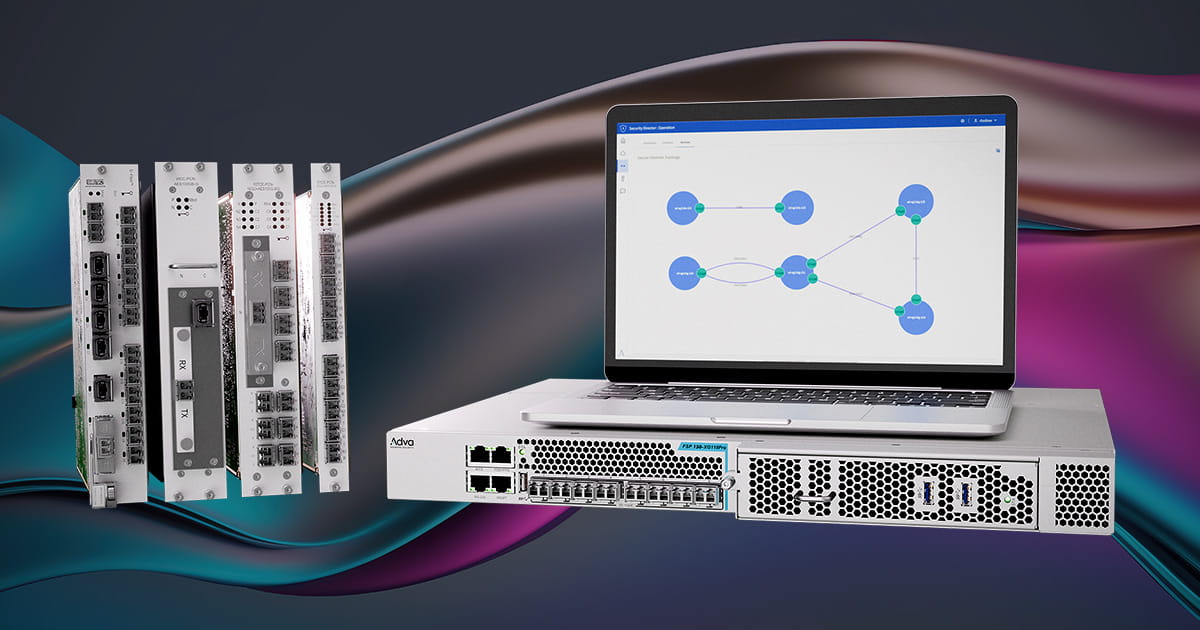
FSP 3000 – Quantum-secure optical transport
Integrated encryption and key exchange within the transmission modules deliver a completely self-contained PQC solution, specially optimized for critical infrastructures.
FSP 150 – Secure Carrier Ethernet
Built-in security combines automated key rotation with near-complete support for the latest PQC standards.
Security Director
Unified management enables end-to-end policy automation and ensures transparent compliance. It’s a key component for meeting CRA and NIS2 requirements.
Embedded security architecture
No external key servers, no synchronous key distribution and no additional attack vectors.
True quantum security in practice: standards-based, interoperable, highly efficient – and built to reduce risks rather than create new ones.
In a nutshell
- Symmetric keys are not the quantum problem.
- External distribution increases risks rather than security.
- Embedded key exchange in the device is the secure approach.
- Post-quantum cryptography is the security strategy for all applications
At Adva Network Security, we offer a self-contained, embedded, PQC-oriented encryption architecture designed to protect networks today and prepare them for tomorrow.
Secure. Simple. Quantum-safe.